
Peptide oral strip packaging: WVTR, sachet seals and moisture protection
Content updated · Evidence and updates
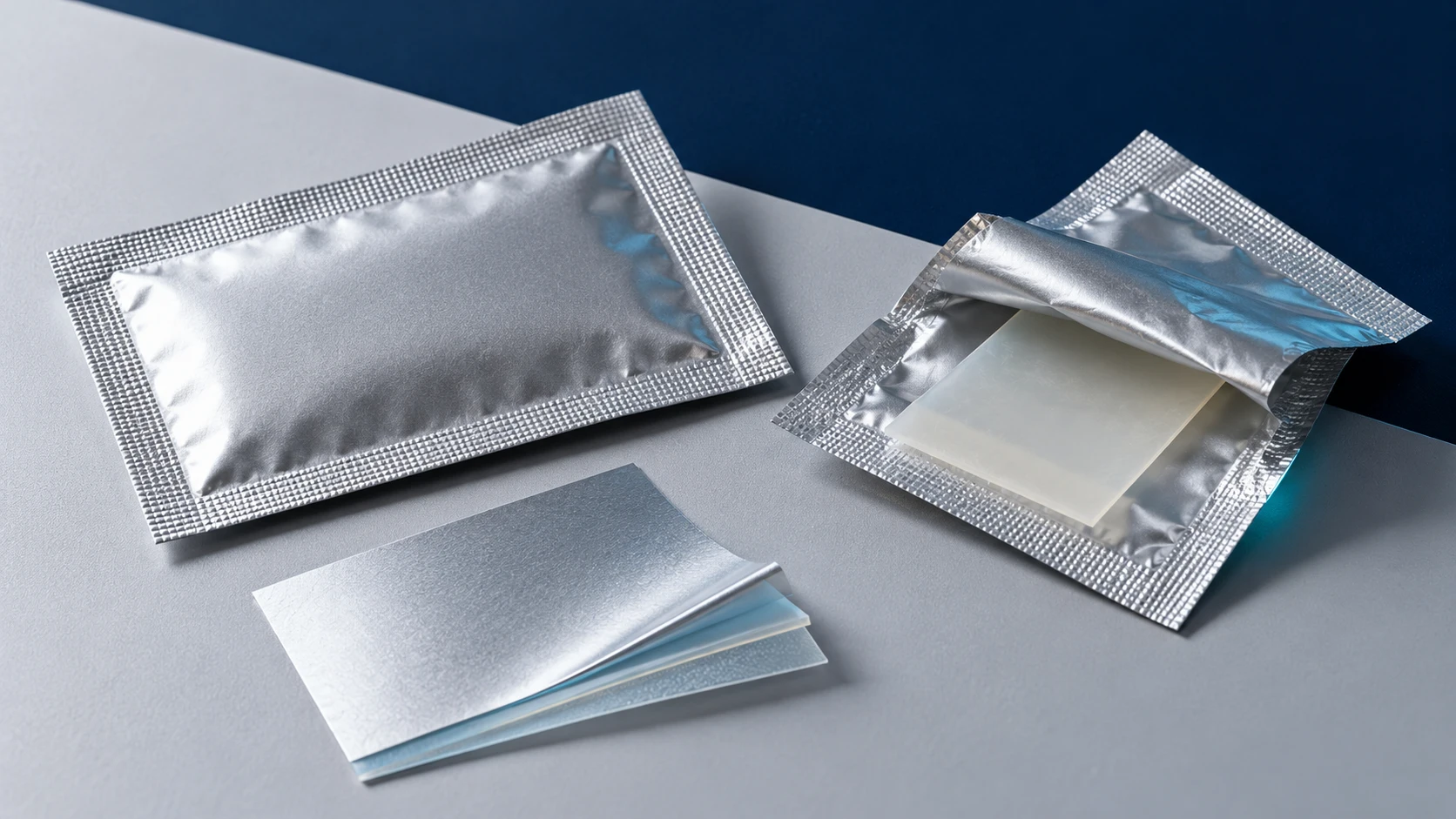
Peptide oral strip packaging needs evidence for the finished sachet as well as its laminate. A WVTR value describes a material under stated test conditions. Seals, pouch geometry and the packing process also affect the package being assessed. Compare those parts together before accepting a shelf-life claim; a low headline transmission rate is only one input to that decision.
Keep the test method, units and conditions together
Water vapor transmission rate, usually reported as mass per area per day, needs its measurement conditions to be interpretable. Temperature and the moisture gradient belong beside the result, along with the material construction and method. ASTM F1249-25 covers water vapor transmission through flexible barrier materials using a modulated infrared sensor. Its public scope reports an interlaboratory-demonstrated range of 0.052 to 26 g/(m²·day). [1] That range is not an oral film packaging specification or a universal instrument limit. A supplier reporting a much lower value should explain the relevant method capability and reporting limit instead of relying on the standard number alone. Compare results on a matching basis. A value measured under one set of conditions cannot simply be ranked against another value from different conditions as though the difference came only from the laminate.
- WVTR value, units and any reporting-limit notation.
- Temperature and stated humidity conditions.
- Material structure, thickness and specimen identification.
- Method edition, applicable capability and result basis.
A simple area calculation shows why pouch size matters
Multiplying a material WVTR by area and time gives an idealized material-flow estimate under the assumptions attached to that rate. For example, assume 0.10 g/(m²·day), a total exposed area of 0.004 m² and 30 days with unchanged test conditions. The arithmetic gives 0.012 g, or 12 mg. The area could represent two hypothetical 4 cm by 5 cm faces before allowing for the actual pouch geometry. This is not a measured ingress result, an estimate of water absorbed by the film or a shelf-life prediction. It omits seal pathways and does not model changing gradients or the package contents. Its practical use is narrower: it shows why an area-normalized material value cannot be treated as the amount entering every sachet. A finished-package assessment must address the actual configuration.
- Hypothetical inputs, with constant stated conditions assumed.
- No claim that the film absorbs all of the calculated mass.
- No estimate of actual sealed-pouch performance.
Assess seals separately from the laminate specimen
A sealed sachet can expose a weakness that a flat-material transmission test never examined. Its perimeter, opening feature and package geometry belong to the finished system. Seal evidence should therefore be connected to the actual material combination and the packing configuration under review. A visible seal can help identify defects, but appearance alone does not quantify moisture protection. Likewise, a seal-strength result answers a different question from a barrier or leak assessment. FDA's final 1999 container-closure guidance discusses protective performance and sealed flexible packages for pharmaceutical products. [2] It is used here as packaging background, not as a claim that dietary oral films follow a particular drug approval pathway. Request the relevant finished-package records and their acceptance criteria. Keep those criteria distinct from a laminate supplier's material specification when comparing offers.
| Evidence level | Useful scope | Remaining question |
|---|---|---|
| Flat laminate WVTR | Material under its stated conditions | Behavior of the finished sachet |
| Seal evaluation | The sealing attribute actually assessed | Other pathways and product stability |
| Finished-package assessment | Defined pouch and packing configuration | Compatibility with the actual film over storage |
| Packed-product stability | Formula and pack under the study conditions | Applicability after a material or configuration change |
Packaging protection must be linked to the actual film
A moisture change can matter to an oral film even when the pouch still looks intact. The relevant effect may concern handling, adhesion, disintegration or an analytical quality attribute. Which effect controls the specification depends on the formulation and its intended storage conditions. Ask for the product and packaging versions covered by the available stability evidence. A new laminate, seal construction or pouch dimension may change the basis for that evidence. The FDA packaging guidance identifies protection, compatibility and other suitability questions for pharmaceutical packaging. [2] Those concepts help structure a technical discussion, but they do not establish a shelf life for this website's film concepts. Avoid importing a generic expiry period from a brochure. The appropriate conclusion follows from the agreed quality attributes and relevant packed-product data, with any remaining limitations stated in the project documents.
- Formula and package versions covered by the study.
- Storage conditions and actual time points.
- Product attributes tested and the acceptance basis.
- Assessment of changes to the pack or film.
Compare packaging quotations on the same evidence basis
A packaging comparison should distinguish what is included from what still needs qualification. One quotation may include material data only, while another includes a defined finished-sachet assessment. Those scopes cannot be compared by the foil description or nominal thickness alone. Ask each supplier to identify the laminate construction, the claimed barrier property and the conditions supporting it. Confirm who owns the seal assessment and the packed-product stability work. If the evidence comes from a different film or pouch geometry, record that limitation instead of treating it as equivalent. Commercial quantities, artwork and opening features should be agreed after the technical assumptions are clear. Ask whether the quoted barrier tests use flat specimens or finished pouches, and whether the reported values cover the exact material being offered. Assign the remaining qualification work before an order is confirmed.
- Material specification and traceable technical data.
- Finished-pack evidence included in the quotation.
- Scope of seal and compatibility assessment.
- Responsibility for storage studies and change review.
Buyer FAQ
Does zero reported WVTR mean absolutely no moisture transmission?
A reported zero may reflect a reporting convention or a value below the relevant method capability. Ask for the detection or reporting limit and the conditions before interpreting it as a physical claim.
Can a foil laminate guarantee the shelf life of a peptide oral strip?
No material description alone establishes shelf life. The finished pouch and actual film need relevant protective, compatibility and stability evidence.
Is the 12 mg example a predicted gain in film moisture?
No. It is an idealized material-flow calculation using hypothetical inputs. It does not model actual pouch ingress, the changing moisture gradient or the amount retained by a film.
Should sachet dimensions appear in a packaging brief?
Yes. Dimensions affect the geometry being assessed. Record the actual configuration, material and opening features so the evidence can be related to the intended pack.
Need a project-specific feasibility review?
Send the target ingredient, intended market, film size, dose range and expected annual volume.
Contact the technical team